
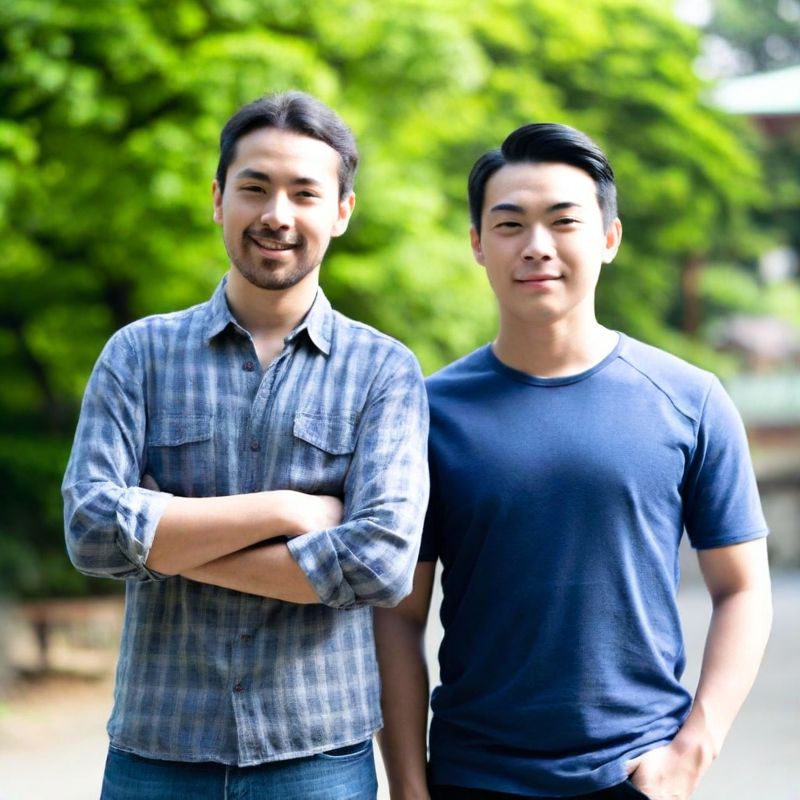
I have tried to repress that unproductive thought: that this is the anti-white and Asian men era, but I couldn’t. It started as I was playing with two AI-art generators: Google’s ImageFX and Canva’s Magic Studio. Unless I specifically requested “white or Asian male,” every human image generated was everything but.
That reminded me that whenever I search Google images, if it’s for a positive character, for example, a scientist, most of the images are female or BIPOC (Black and Indigenous people of color,) usually both. If it’s a negative character, for example, a sleazy salesperson, it’s almost always a white man.
I turned to selecting the voice for the audiobook version of my recently Amazon-published book, How to Do Life. The default was a minority woman. That reminded me that it was true for all my Amazon-published books.
That, in turn, reminded me that news media, entertainment media, and even advertisements usually omit or disproportionately portray Asian and especially white men negatively, especially if they’re successful and not a creative such as a writer or musician. If it’s a BIPOC, especially a BIPOC woman, it’s almost always a positive character.
In turn, that reminded me that in any Google search, which of course, includes text sources, white and Asian men are usually lower in the search results compared with women, especially BIPOCs.
Is this inadvertent? In a recent interview with Silicon Valley legend Marc Andreessen, Free Press’s Bari Weiss asked whether the bias is intentional. Here is his answer:
“At these big companies, there’s been absolute intentionality. That’s how you get black George Washington at Google, because there’s an override in the system that basically says, everybody has to be black. Boom.
There are large sets of people in these companies that determine these policies and write them down and encode them into these systems. So overwhelmingly, what people experience is intentional. There’s just no question about that. These companies were born woke. They were born as censorship machines.
My concern is that the censorship and political control of AI is a thousand times more dangerous than censorship and political control of social media — maybe a million times more dangerous. Social media censorship and political control is very dangerous but at least it’s only people talking to each other and communicating.
The thing with AI is I think AI is going to be the control layer for everything in the future — how the healthcare system works, how the education system works, how the government works.
So if AI is woke, biased, censored, politically controlled, you are in a hyper-Orwellian, China-style nightmare. This hasn’t rolled out all the way yet because AI is still new and not in charge yet. But this is where things are headed.
It’s vitally important that this does not happen. My hope is that the culture changes and this all gets peeled back and thrown out into the sunlight and that people come to understand this and don’t stand for it. But this has to be fought. This will happen by default unless people fight it.”
I worry that people will not fight it — Most people are unaware of the profound bias or have been brainwashed that Asian and especially white men deserve to be biased against and, for example, must “surrender their privilege.”
PubMed searches most medical journals. Search on “men’s health” then “women’s health.” Far more research and outreach are on women’s health. That is particularly unfair in that men have the ultimate deficit: We die six years younger. Yet when women have a less fatal “under”representation, for example in STEM, billions have been spent to get more women, which by definition, means fewer men.
I fear that the anti-Asian and especially anti-white-men bias will continue to accelerate given the Woke-Left’s takeover of society’s mindmolders — the schools, colleges, and media. That said, my next post offers eight ways that we, as individuals can slow down and maybe even stop the unfairness.
I read this aloud on YouTube.

Marty holds a Ph.D. from U.C. Berkeley with specializations in educational psychology and the evaluation of innovation, is a career and personal coach, and author of 35 books including A Dose of Reality. You can reach him at mnemko@gmail.com
The views and opinions expressed in this writing are solely those of the author and do not necessarily reflect the beliefs or positions of The Boys Initiative.