
Millions of parents, us included, lie sleepless at night worrying about their smart sons’ ability to access a college degree. The data shows people with a four-year degree have higher career earnings, better marital prospects, and better health. They also pay more in taxes and require fewer social services.
Fewer than 40% of college graduates are now male. But now the shortage of male graduates is hurting the rest of society as well. One college closes every week. Some 1,000 young men die from deaths of despair And the acute shortage of skilled workers with college degrees in STEM is damaging our economy and even national defense.
The theories bandied about all lack evidence and are easily disproven. The research and data lead us to a different answer: The boys are fine. School grading is not.
Grading in every school and college involves behavior. That behavior has nothing to do with learning and knowledge, and nothing to do with future work performance. Common male classroom behavior is penalized, resulting in resulting in lower grades than females. Gender based behavior for both sexes is determined before birth by brain neurology and biology, as scientists know. The primary male behaviors being punished in the classroom are turning work in late, doing less work, not doing assignments, and being absent from or late to class. But the list goes on, and includes challenging the teacher, speaking out of turn, looking out the window, not talking enough, even staring.
Gender differences in male and female neurology explain these boy behaviors. Boys spend 30% less time on schoolwork than girls, but they learn as much. Boys are significantly more likely to be bored by their schoolwork. It is actually physically painful for smart boys to do easy work. We know twice as many boys as girls are suspended from school. Male gender behavior, such as taking risks, failing, tackling harder work, challenging, competing, and completing a task in less time, all are rewarded in the workplace but penalized in the classroom. Giving boys worse grades has wide and lasting consequences.
In addition, the data shows that boys’ school behavior has nothing to do with performance in the workplace. According to the Bureau of Labor Statistics annual survey, male workers, starting at age 16, show up on time in the workplace. They have no problem getting their work done on time. Males also have a lower rate of absence, and work longer hours as well.
The disconnect between grades and knowledge has been thoroughly documented when Nancy S. Cole, when she was President of the Educational Testing Service, co-authored a study of millions of students taking thousands of tests. The book, Gender and Fair Assessment, reported some 36% of male students were given significantly worse grades than their test scores warrant. At the highest levels on tests and the lowest grades, it is boys 90% and girls 10%. We need these smart boys as college graduates and in STEM. But there are 2 million boys missing from college every year, boys who know just as much as students in college.
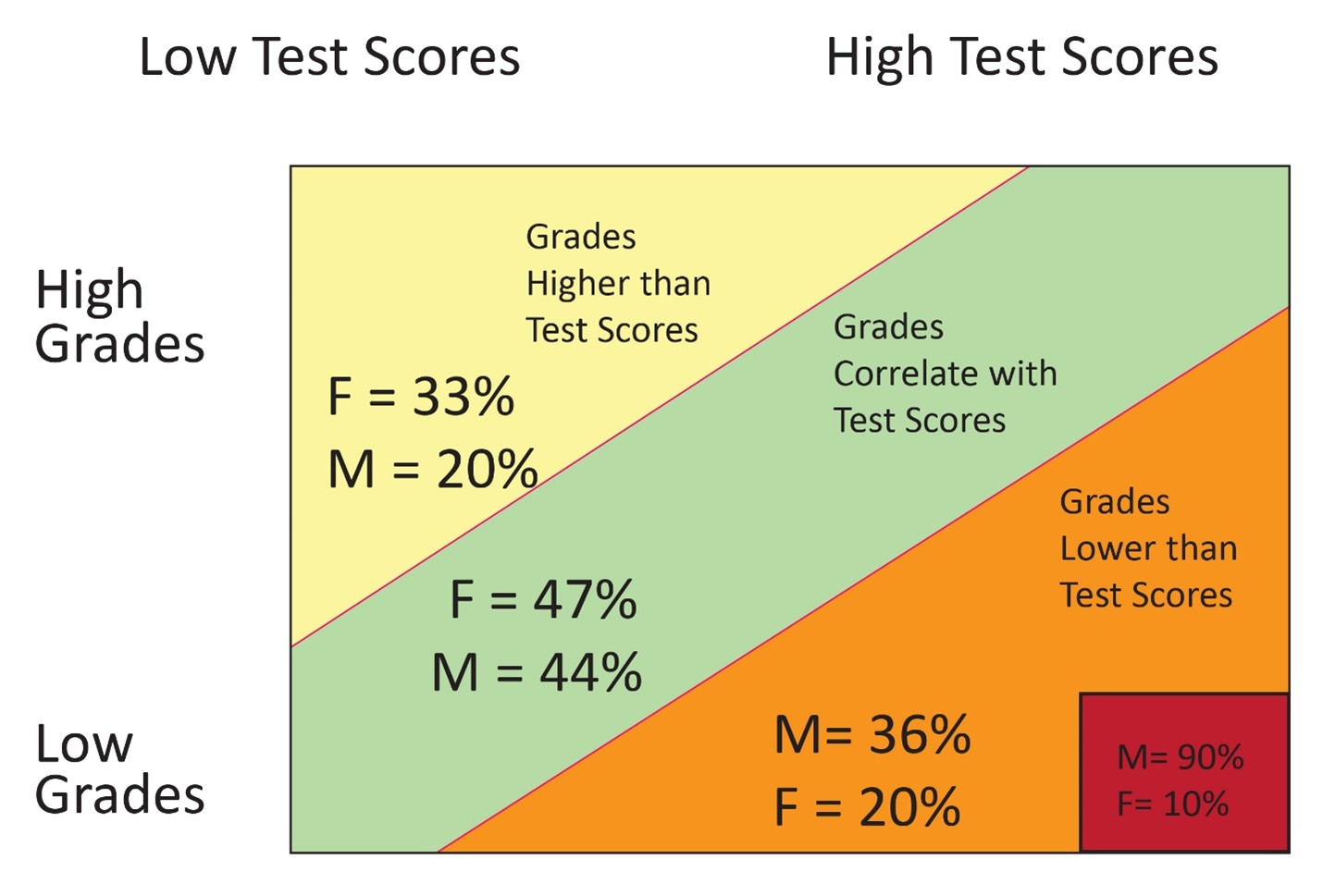
We drilled down to the local level and analyzed high school grades in 18 representative, often large, school districts in Wisconsin. Despite male and female students testing equally well, only half as many boys as girls are given a 3.9 GPA (Grade Point Average), a traditional measure for gaining entry into the most selective colleges and universities. One and a half times as many girls as boys are given a 3.5 GPA, the recommended GPA for research universities. At 3.0 GPA, the minimum generally needed for any university, fewer than half of boys have a 3.0 or better, while almost two-thirds of girls qualify. Other studies, such as this one, confirm our findings.
The shortage of male college graduates directly causes a shortage of skilled workers in STEM and in other fields. Societally that means smaller tax revenues and exacerbating social service costs and more single parent families. This hurts both college and non-college educated people, since a community’s economic prosperity for both college and high school graduates is determined by the percentage of adults with a four year degree.
While behavior-based GPA remains the primary criterion for college entrance, it has been discredited. Teachers give fewer than half of their students a grade appropriate to their learning and knowledge. Teachers flunk at grading. Employers increasingly disregard GPA as a metric by which they evaluate new hires. Colleges and universities need to admit students based on their learning and knowledge, not behavior.
The solution works and Americans approve of it. India measures only learning and knowledge, not behavior. India has a high volume of male STEM students. It also has gender parity in graduates, as should be the case here. U.S. employers urge Congress to increase H-1B visas. With 71% of the H-1B visa workers coming from India. U.S. universities admit STEM students from India without requiring behavior measurements. Americans are just fine, including us, with being operated on by a surgeon who graduated from medical school in India.
India is also important as America continues to lack STEM workers. Another U.S. company every week sets up shop in India to recruit its engineers, 1,800 companies and counting. That answer may work for business, but it does not work for our economic prosperity and national defense.
Two national organizations support grading solely on learning. The Boys Initiative is at the forefront of eliminating gender bias in grading. The Learning Resources Network (LERN) is the leading continuing education association.
We want to be clear that women do not benefit from gender discrimination against males. We need more, not fewer, women and men with four-year degrees. Women and children benefit economically and in every other way from having more males with a college degree. The solution is no-cost and benefits everyone. America needs the solution.
The views and opinions expressed in this writing are solely those of the author and do not necessarily reflect the beliefs or positions of The Boys Initiative.

Julie Coates and William A. Draves are authors of the book, Smart Boys, Bad Grades: Gender Inequality and STEM in Education. They are parents, educators and mentored 18 boys. Coates is Senior Vice President, and Draves President, of the Learning Resources Network (LERN), a national association in continuing education.